
Pillar Machine | LARICK 260 Profile Sander
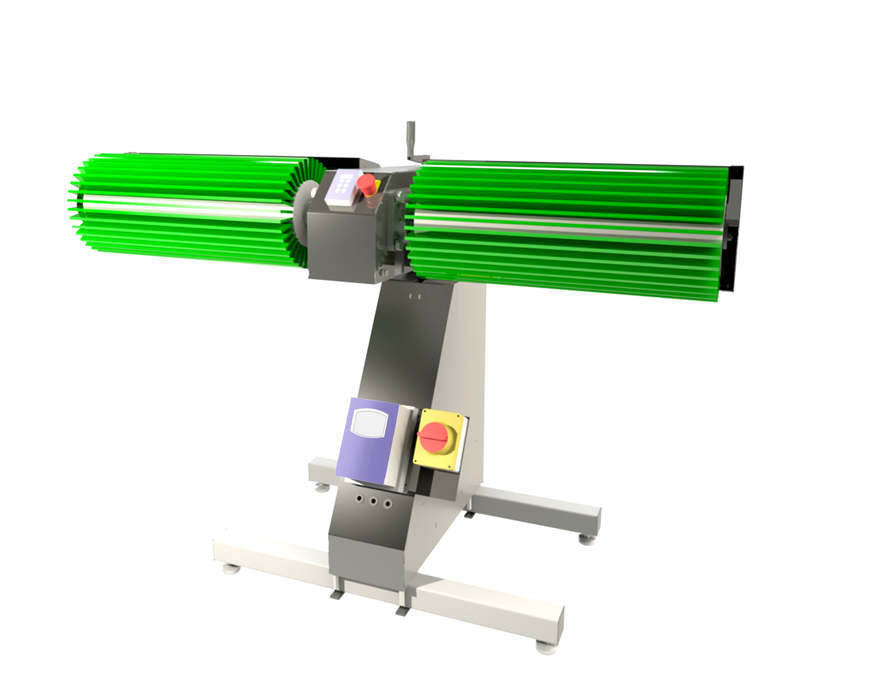
The Model 260 Profile Sander is a horizontal spindle machine designed for use with flexible brush type sanding wheels. Standard spindles are 600mm (24 inch) long on both sides. They can also be shortened. Dust collection hoods are standard, as well as height adjustment.
260 Profile Sander
The 260 Series Profile Sander is a horizontal spindle machine designed for use with flexible brush type sanding wheels. The base machine has 40mm diameter spindles extending 175mm on both sides. 50mm diameter extensions can be added to either or both sides. In addition, the spindle height can be easily adjusted. Variable spindle speed is inverter controlled
The spindle’s rotation can be changed to allow sanding to be performed on top or bottom of the brushes. The bases can be moved side to side to provide clearance for the operator.
The inverter keypad provides Start/Stop, Speed, and rotation direction control. Different sanding strips can be used on long spindles to vary sanding by changing brush lengths, grits, and abrasive types. Double sided strips can also be used to do whitewood sanding in one direction, and sealer sanding by reversing the rotation. Spindle height is easily adjusted.
Machine Specifications
- Motor: 1.5 HP 3ph
-
Voltage
- Model 261: 120 or 208-240V 1ph 50-60hz
- Model 262: 208-240V 1 or 3ph 50-60hz
- Model 264: 400-480V 3ph 50-60hz
- Variable Speed: AC Inverter, 100-800rpm
- Spindle: 40mm Dia. By175mm
- Long Spindle Extensions: 50mm OD, 600mm
- Maximum Length Spindle Height: 34 to 49 inches
- Footprint: 60 by 27.5 inches
Specifications
Pillar Machine LARICK 260 Profile Sander – Frequently Asked Questions
What is the Pillar Machine LARICK 260 Profile Sander?
The LARICK 260 Profile Sander is an American-made industrial profile sanding solution designed for mid-level to higher-production woodworking operations. It delivers uniform contour sanding for cabinet doors, mouldings, architectural profiles, and other shaped wood components where consistent surface finish and throughput are priorities.
Is the LARICK 260 made in America?
Yes. The LARICK 260 is manufactured in the United States by Pillar Machine, offering domestic build quality, robust structural design, and faster access to U.S. parts and service support compared with many imported alternatives.
Who is the LARICK 260 best suited for?
This model fits woodworking shops, cabinet manufacturers, and millwork facilities that need more sanding capacity and production efficiency than entry- or lower-mid-level models (like the LARICK 150 and 220) but do not yet require the heavier capacity of the LARICK 360.
How does the LARICK 260 compare to the LARICK 230?
The LARICK 260 builds on the 230’s capabilities with a larger sanding envelope and more robust components, enabling greater throughput and deeper profile sanding while maintaining the accessibility and ease of operation expected in mid-size profile sanders.
Can the LARICK 260 replace hand sanding?
Yes. The LARICK 260’s mechanical sanding consistency significantly reduces the need for manual hand sanding, increasing production speed and improving finish uniformity compared with manual methods.
Is the LARICK 260 suitable for moderate to high production?
Yes. Built with heavier structural members and industrial components compared with smaller models, the 260 can reliably support moderate to higher production schedules where repeatable sanding results are expected.
What materials can the LARICK 260 process?
The LARICK 260 is compatible with solid hardwoods, softwoods, MDF, plywood, composite mouldings, and engineered panels commonly used in cabinetry and architectural millwork.
How does American manufacturing benefit machine longevity?
American fabrication brings quality control and robust structural integrity, resulting in less vibration, longer service life, and easier access to replacement parts and technical support when compared with many imported alternatives.
Does the LARICK 260 improve finish preparation?
Yes. Uniform sanding pressure and contour tracking promote consistent surface quality for stain, paint, or topcoat applications, reducing rework and finish variability.
How does the LARICK 260 differ from the LARICK 150?
The 260 offers a larger sanding envelope, heavier-duty components, and stronger overall capacity for higher throughput and a broader range of profile shapes, while the 150 is optimized for smaller parts and lighter duty work.
Is the LARICK 260 easy to operate?
Yes. Controls, setup, and adjustments are intuitive, allowing operators to achieve consistent sanding results with minimal training while improving overall production efficiency.
Does the LARICK 260 require extensive maintenance?
No. Routine maintenance points such as sanding belt changes, bearing checks, and lubrication are designed for accessibility, helping to minimize downtime and support continuous use.
Can the LARICK 260 handle custom profiles?
Yes. With proper tooling and setup, the machine accommodates a variety of decorative contours required by cabinetry, architectural millwork, and custom woodworking applications.
Does the LARICK 260 support dust collection systems?
Yes. It includes dust porting designed to integrate with proper extraction systems, helping manage airborne particulates and maintain a cleaner working environment.
How does the LARICK 260 affect labor utilization?
By automating profile sanding and reducing manual finishing, the 260 frees up skilled labor for higher-value tasks, improving overall shop productivity and efficiency.
Is the LARICK 260 a good investment for growing shops?
Yes. It offers a combination of robust capacity, productivity gains, and American-made reliability that supports shops transitioning toward higher production without the footprint and cost of larger industrial models.
What safety features are included?
The LARICK 260 includes guarding, emergency stop controls, and dust porting that should be used with appropriate extraction and personal protective equipment for safe operation.
How does the sanding capacity of the LARICK 260 compare to the LARICK 360?
The 260 provides a substantial sanding envelope and capacity suitable for growing production but has a smaller footprint and slightly lower throughput potential than the heavier-duty 360 model.
Does American build quality affect resale value?
Yes. Robust U.S. build standards and domestic support commonly improve resale value and attractiveness to buyers seeking long-term reliability and serviceability.
Does the LARICK 260 increase throughput?
Yes. By automating profile sanding and reducing hand sanding, it increases part output and lowers labor time per part compared with manual processes.
Why choose the LARICK 260 over imported profile sanders?
The LARICK 260 delivers American-made build quality, accessible parts and service support, stronger structural durability, and superior long-term performance compared with many imported machines with weaker support networks.