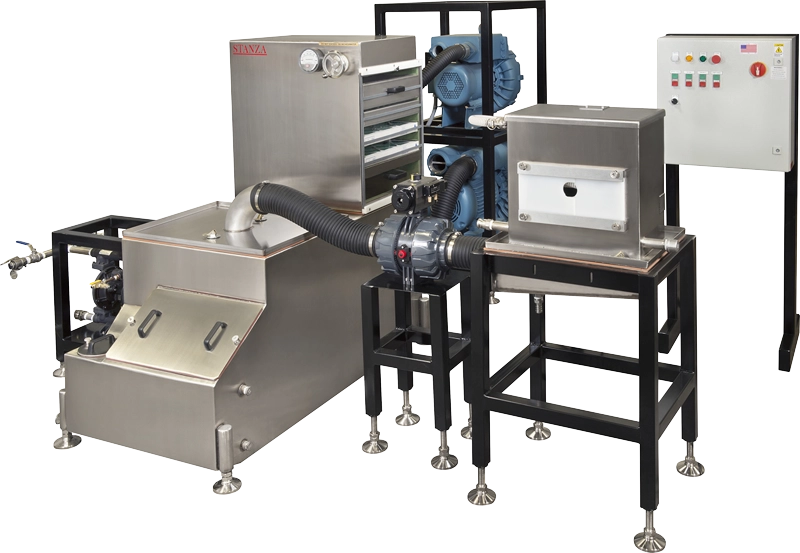
What is the STANZA MACHINERY MC/UV-300R Tube & Pipe Coater?
The STANZA MACHINERY MC/UV-300R Tube & Pipe Coater is an automated finishing system designed to apply UV-curable coatings evenly to cylindrical and round components such as tubes, pipes, rails, posts, and round profiles with consistent film build and instant curing.
What types of applications is the MC/UV-300R best suited for?
The MC/UV-300R is ideal for coating round and tubular parts used in furniture manufacturing, cabinetry components, architectural millwork, stair systems, railings, and decorative cylindrical elements where speed and finish consistency are critical.
What materials can the MC/UV-300R Tube & Pipe Coater process?
The system is commonly used on solid wood, MDF, veneered components, and engineered substrates formed into round or cylindrical profiles.
What type of coatings does the MC/UV-300R use?
The MC/UV-300R is designed specifically for UV-curable coatings, including UV sealers, primers, base coats, and topcoats used in high-performance industrial finishing environments.
How does a UV tube and pipe coater work?
The MC/UV-300R applies coating while rotating the part to achieve 360-degree uniform coverage, followed immediately by UV curing, allowing parts to be handled or stacked as soon as they exit the system.
How does UV curing benefit tube and pipe finishing?
UV curing provides instant cure times, eliminating drying delays, increasing throughput, reducing work-in-process inventory, and enabling continuous high-speed production of cylindrical components.
How does the MC/UV-300R compare to manual spray finishing?
Compared to manual spraying, the MC/UV-300R delivers greater consistency, minimal material waste, reduced labor, and repeatable finish quality, especially on round parts that are difficult to coat evenly by hand.
Who should consider the MC/UV-300R Tube & Pipe Coater?
The MC/UV-300R is ideal for furniture manufacturers, millwork shops, stair and railing producers, and high-volume component manufacturers that require fast cycle times and consistent, production-grade finishes on cylindrical parts.
Is the MC/UV-300R suitable for high-production environments?
Yes. The MC/UV-300R is engineered for mid-to-high production environments, supporting continuous operation with repeatable results and minimal downtime.
How does the MC/UV-300R improve finish consistency?
By controlling part rotation, coating delivery, and UV cure intensity, the MC/UV-300R eliminates operator variability and produces uniform film thickness and appearance on every part.
Does the MC/UV-300R reduce labor requirements?
Yes. Automating coating and curing significantly reduces reliance on skilled spray labor and allows operators to manage higher output with fewer personnel.
Is the MC/UV-300R environmentally efficient?
Yes. UV coatings produce low emissions, minimal waste, and no overspray, making the MC/UV-300R a clean and efficient finishing solution compared to traditional spray methods.
Can the MC/UV-300R be integrated into an automated finishing line?
Yes. The MC/UV-300R integrates seamlessly with conveyors, material handling systems, sanding equipment, and automation, enabling continuous cylindrical finishing workflows.
What is the difference between the MC/UV-300R and the MC/WB-300R?
The MC/UV-300R uses UV-curable coatings with instant curing, maximizing speed and throughput, while the MC/WB-300R uses water-based coatings that rely on air or oven drying. Both systems deliver uniform 360-degree coverage, but they serve different coating chemistries and production strategies.
How does the MC/UV-300R differ from flat-panel vacuum coaters?
Unlike vacuum coaters designed for flat or profiled panels, the MC/UV-300R is engineered specifically for round and cylindrical parts, using rotation rather than vacuum pressure to achieve even coverage.
Is financing available for the STANZA MACHINERY MC/UV-300R Tube & Pipe Coater?
Yes. Flexible financing options are available through Centex Automation, allowing manufacturers to invest in high-speed UV cylindrical finishing while managing capital expenditures.