
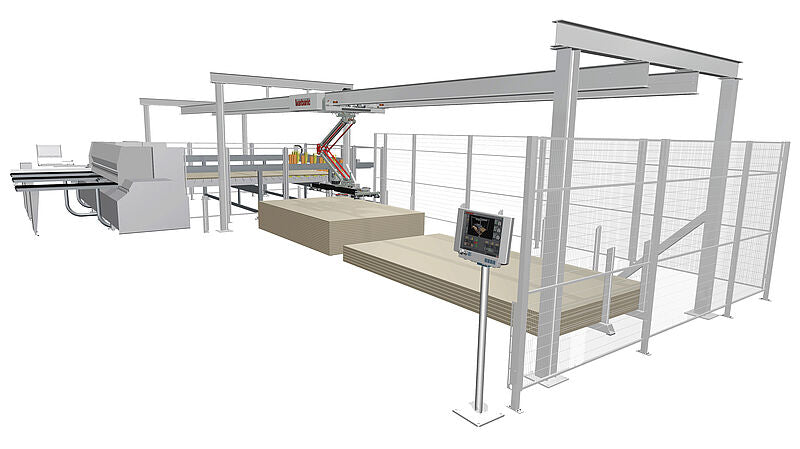
BARBARIC | LCV Feeding System
A Barbaric LCV feeding system allows for easy and fast feeding of your manufacturing machine. In this area we can offer custom-made systems built with simple yet high-quality components. Benefits are low space requirement and the elimination of physically challenging work for production workers. It‘s an investment with tremendous value for craft and industry production.
Function and operation:
- Control via operator terminal
- visualization in 2D and 3D system
- simple and intuitive user interface
- fully automated standardized hard ware interfaces for different saw manufacturers
- automated panel feeding
Your benefits at a glance:
- optimized material flow
- gentle manipulation: no damage of the panels during transport
- optimization of space
- reduced personnel expenses
- simplification and alleviation of production processes
- higher capacity utilization of your manufacturing machine
- flexibility in production processes
- payback periods below one year possible
- fully automated panel handling
Specifications
What is the BARBARIC LCV Feeding System?
The BARBARIC LCV Feeding System is an automated panel feeding solution designed to quickly and ergonomically feed a downstream manufacturing machine (such as a beam saw or CNC) using a compact layout.
What machines can it feed?
It is designed to feed manufacturing machines including pressure beam saws and CNC equipment, and can be integrated with existing manual-load panel saws depending on configuration.
Is it compatible with different saw manufacturers?
Yes. It is described as using standardized hardware interfaces for different saw manufacturers.
How does it improve throughput?
It supports optimized material flow and automated panel feeding to improve downstream machine utilization while reducing manual handling and fatigue.
How does it protect panels?
It is promoted for gentle manipulation to help reduce scratches and damage during transport and feeding.
How is it operated?
Operation is via an operator terminal with 2D/3D visualization and an intuitive user interface.
What axis configurations are available?
Published summaries describe a two-axis standard system (often XZ) with an optional three-axis system (XYZ), depending on application.
How long can the system be?
Published specifications list standard design up to 164 ft (50 m), with extension possible based on layout and needs.
What panel sizes can it handle?
Published specs list panel length typically 78.7–165.4 in (2,000–4,200 mm) and width 23.6–82.7 in (600–2,100 mm), with longer sizes available on request.
What panel thickness can it handle?
Published specs list a standard minimum thickness from 0.31 in (8 mm), with exact ranges depending on configuration.
What panel weight can it handle?
Published specs list up to 441 lb (200 kg) standard, with optional configurations up to 661 lb (300 kg).
What movement speeds are typical?
Published specs list X-axis speed from 262.5 ft/min (80 m/min) and Z-axis speed of 82 ft/min (25 m/min), depending on configuration.
What stack height can it work with?
Published specs list stack height up to 70.8 in (1,800 mm), depending on system design.
Can it be customized for loading direction?
Yes. Published literature notes loading can be customized from left, right, or rear to meet space requirements.
Does it reduce labor and fatigue?
Yes. It is promoted for eliminating physically challenging manual feeding work and reducing operator fatigue.
Does it require a lot of floor space?
BARBARIC highlights low space requirements, though final footprint depends on layout and integration.
What production environments is it for?
It is positioned for both craft and industrial production where automated panel feeding improves workflow.
What is the typical payback?
Published messaging notes payback below one year may be possible depending on utilization and labor savings.
Can it upgrade an existing manual-load saw?
Yes. LCV literature promotes adding automatic loading to existing manual-load panel saws.
Why do shops add an LCV system?
To improve throughput and utilization, reduce labor and fatigue, minimize panel damage, and optimize material flow.